
Most families I talk to see education as a way to give their kids options.
Not just college, but optionality—freedom to choose a path, explore interests, and build a life with a bit more support behind them.
When we start talking about how to plan for that, most people immediately think of 529 plans. And they can be a great tool. But they're not the only way to approach it—and in some cases, they're not the best fit depending on the family.
There are actually a few different ways to think about setting money aside for education, each with its own trade-offs around flexibility, control, and tax treatment.
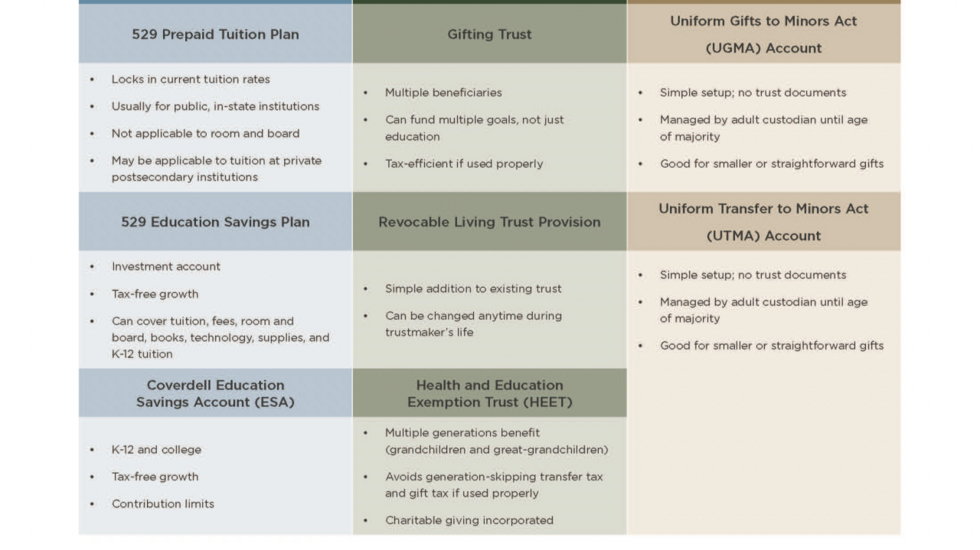
1. Gifting Trusts: Flexibility with Structure
A gifting trust allows you to set aside money for a child (or grandchild) while maintaining some structure around how and when it's used.
Unlike a simple account in a child's name, you're not handing over full control at age 18 or 21. Instead, you can guide how the funds are used—whether for education, or potentially other life needs down the road.
These trusts are often designed to take advantage of annual gift tax exclusions, so you can move money out of your estate over time while still keeping things intentional and protected.
For families who want flexibility without giving up control too early, this can be a useful option.
2. Health and Education Exclusion Trusts (HEETs): For Multi-Generational Planning
For families thinking more broadly—across multiple generations—a Health and Education Exclusion Trust can come into play.
This is a more advanced strategy, but at a high level, it allows you to pay for education (or medical expenses) for grandchildren and beyond in a way that can avoid certain transfer taxes that would normally apply.
There's a charitable component built in, which is what makes the structure work from a tax perspective.
It's not something most families need, but in the right situation, it can be a powerful way to support education across generations while also incorporating charitable goals.
3. Your Revocable Living Trust: Built-In Planning
Sometimes the simplest solution is already part of your plan.
Your revocable living trust can include provisions that set aside funds for education if something happens to you. That way, your kids or grandkids are supported, even if you're not there to guide things directly.
The benefit here is flexibility—you can define what “education” means, how funds are distributed, and what guardrails (if any) you want in place.
And you're not locking all of your assets into education-specific planning. You're simply making sure it's accounted for.
4. 529 Plans: Tax Advantages with Some Constraints
529 plans are often the starting point—and for good reason.
They offer tax-advantaged growth, and funds can be used for a wide range of qualified education expenses, including tuition, room and board, and even certain K–12 costs.
Recent changes have added more flexibility, including the ability (in some cases) to roll unused funds into a Roth IRA for the beneficiary.
That said, there are still limitations:
- Funds generally need to be used for qualified education expenses
- Overfunding can create inefficiencies
- You're giving up some flexibility compared to trust-based planning
For many families, 529s are a great piece of the plan—but not necessarily the whole plan.
5. Coverdell ESAs and Custodial Accounts (UTMA/UGMA)
There are also simpler tools that can be used in the right context.
A Coverdell ESA allows for tax-free growth when used for education, including K–12 expenses, but comes with lower contribution limits and income restrictions.
Custodial accounts (UTMA/UGMA) are even simpler—they allow you to set aside money for a child without creating a trust. But they come with a trade-off: once the child reaches a certain age, the money is theirs to use however they want.
That may be fine in some families—but it's something to be intentional about.
A Note on Financial Aid
One piece that often gets overlooked is how these accounts are treated for financial aid purposes.
Depending on how assets are structured and who technically owns them, they may impact eligibility for need-based aid.
It's not always a reason to avoid planning—but it's something to be aware of when choosing the right approach.
There's No One-Size-Fits-All Answer
What I've found is that this isn't really about picking the “best” tool.
It's about aligning the strategy with:
- your family dynamics
- your values
- how much control you want to keep
- and how much flexibility you want to preserve over time
For some families, a simple 529 plan is more than enough.
For others, a more thoughtful structure can make a real difference—not just financially, but in how the support is actually used.
If you've been thinking about how to plan for education for your kids or grandkids, I'm always happy to talk it through in a real-world way.
